What Is Thatch? How to Spot It in an Ohio Lawn
Thatch is one of the most misunderstood things in lawn care. Half the homeowners we talk to in Kettering and Centerville think it means the dead grass clippings sitting on top of the lawn. It does not. And that misunderstanding leads a lot of people to attack a problem they do not have, with a machine that will hurt their lawn.
What Thatch Actually Is
Thatch is a layer of living and dead organic matter that sits between the green grass blades and the soil surface. It is made mostly of stems, crowns, and roots — the tough, stringy parts of the grass plant that resist decomposition because they are high in lignin.
Grass clippings are not thatch. Clippings are roughly 85% water and break down within a couple of weeks. Mulching your clippings back into the lawn does not create a thatch problem — that is one of the most persistent myths in lawn care. Thatch comes from the woody tissue at the base of the plant, not from the leaf you cut off the top.
What Thatch Looks Like
If you part the grass with your fingers and look down at the soil line, thatch is the spongy, tan-to-brown, felt-like mat you see. It has a distinct texture — fibrous and interwoven, a bit like a coarse doormat or a thin layer of peat moss. Fresh thatch is light brown and springy. Older thatch compresses into something denser and darker.
The easiest way to see it properly is to cut a small wedge out of the lawn with a spade, about three inches deep, and look at it from the side. You will see three distinct bands: green grass on top, a brown fibrous layer in the middle, and darker soil underneath. That middle band is your thatch layer, and now you can measure it.
How Much Thatch Is Too Much?
This is where most people get it wrong in the other direction. A little thatch is good for your lawn. Up to about half an inch acts as insulation and cushioning — it moderates soil temperature, holds moisture, and protects the crowns of the grass plants from foot traffic.
- Under 1/2 inch: Healthy. Leave it alone. Nothing to fix.
- 1/2 to 3/4 inch: Getting thick. Worth managing, usually with core aeration.
- Over 3/4 inch: A genuine problem. Water, air, and fertilizer are struggling to reach the soil.
Why Thick Thatch Causes Problems
Once the layer gets past three quarters of an inch, it starts behaving like a thatched roof — which is exactly what the word originally described. It sheds water instead of letting it through.
- Water runs off instead of soaking in. You water for twenty minutes and the soil underneath is still dry.
- Roots grow into the thatch instead of the soil. This is the serious one. Grass rooted in thatch has no drought reserve, because thatch dries out far faster than soil. That lawn will be the first to go brown in a hot Ohio August.
- Fertilizer and lime get intercepted before they reach the root zone.
- Disease and insects get a home. A damp, dense thatch layer is ideal habitat for fungal disease and for grubs and chinch bugs.
- Mowing gets scalpy. The mower wheels sink into the spongy layer and the blade cuts too low.
What Causes Thatch to Build Up
Thatch accumulates when the grass produces organic matter faster than soil microbes can break it down. Anything that tips that balance builds thatch:
- Over-fertilizing with nitrogen. Pushing hard top growth outruns decomposition. This is the single most common cause we see.
- Compacted soil. Compaction suffocates the microbes that digest thatch. Fewer microbes, more buildup — and this is why compaction and thatch so often show up together.
- Heavy clay. Much of the Miami Valley sits on dense clay subsoil, which drains poorly and holds less oxygen.
- Grass type. Kentucky bluegrass and creeping red fescue spread by rhizomes and stolons and naturally produce more thatch. Perennial ryegrass and tall fescue produce very little.
- Frequent light watering. Shallow watering keeps the thatch layer damp and encourages roots to stay in it.
- Fungicide and pesticide overuse. Broad applications can suppress the soil life doing the decomposing.
How to Deal With Thatch
There are two mechanical approaches, and they are not interchangeable.
Core aeration
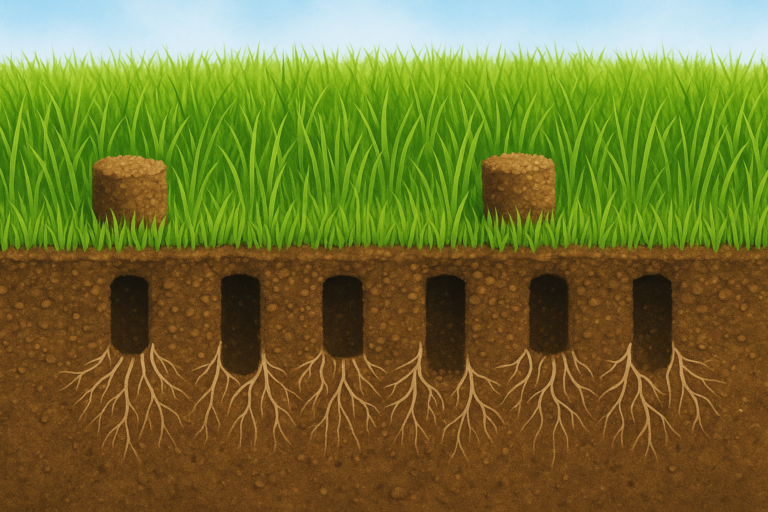
Core aeration pulls plugs of soil up through the thatch layer and deposits them on the surface. Those plugs are full of soil microbes, and as they break down they seed the thatch layer with exactly the biology that digests it. At the same time, aeration relieves the compaction that suppressed those microbes in the first place.
This is slower than dethatching, but it treats the cause rather than the symptom, and it does not damage the lawn. For thatch under about three quarters of an inch, it is almost always the right answer.
Dethatching
A dethatcher uses flails or steel tines to physically rip the thatch layer out. It is fast and dramatic, and it is genuinely hard on the lawn — you will tear out healthy grass along with the thatch. It is the right tool when the layer is over an inch and truly needs removing, and the wrong tool for anything less.
We go through the trade-offs in detail in aerating vs. dethatching.
The Long-Term Fix Is Soil Biology
Mechanical removal treats the symptom. Thatch will come straight back if the underlying conditions have not changed. The lasting fix is making your soil a better place for the microbes that eat thatch: relieve compaction, ease off the nitrogen, water deeply and less often, and keep oxygen moving into the root zone.
That is the argument for annual core aeration rather than occasional emergency dethatching. A lawn aerated every year rarely develops a thatch problem at all.
Not Sure What You Are Looking At?
Cut the wedge, measure the brown band, and you will know. If it is under half an inch, your lawn is fine. If it is thicker than that and you would like a second opinion, we are happy to take a look — aeration and overseeding are the only services we sell, so we have no reason to talk you into work you do not need.
Request a free quote or call 937-304-1888.
Aeration Guides
- What is lawn aeration and what does it do?
- How to aerate your lawn (DIY guide)
- How to overseed a lawn
- When to aerate and overseed a lawn in Ohio
- Spring, fall, or dormant seeding?
- Best grass seed for overseeding in Ohio
- Watering after overseeding
- Aerating vs. dethatching
- How much does core aeration cost?