How to Overseed a Lawn: Step by Step
Overseeding is spreading grass seed into an existing lawn rather than starting over. Done properly it thickens thin turf, fills bare patches, and gradually replaces older grass with varieties that handle Ohio summers better. Done carelessly it is an expensive way to feed birds.
The difference is almost entirely about seed-to-soil contact and watering. Here is the whole process.
What Overseeding Is (and Is Not)
Overseeding adds seed into living turf. The existing lawn stays; you are increasing its density and shifting its composition over time.
Renovation kills the existing lawn and starts fresh. Faster and more complete, dramatically more expensive and disruptive, and rarely necessary unless turf coverage is genuinely poor — below roughly half.
If your lawn is thin but alive, overseeding is almost always the right call. If it is more weed than grass, seed will mostly feed the weeds and you should deal with that first.
When to Overseed in Ohio
Late August through mid-October, with early September the strongest window. Warm soil germinates seed fast, cooler air keeps seedlings from cooking, autumn rain is more reliable, and the summer weeds are finishing rather than competing.
Spring seeding is genuinely harder, for two reasons: new grass gets only a few weeks of root growth before summer heat, and crabgrass preventer stops your grass seed germinating exactly as effectively as it stops crabgrass. Detail in when to aerate and overseed in Ohio.

Step 1: Aerate First
This is the step that decides your germination rate, and it is the one most people skip.
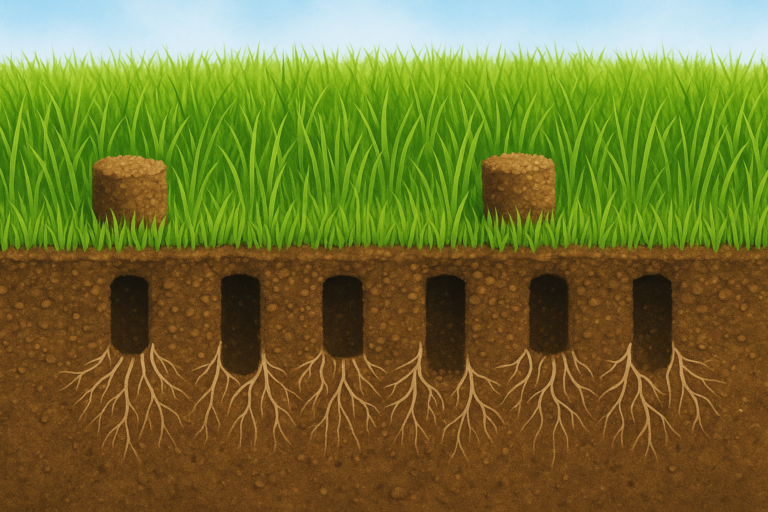
Seed needs contact with soil — not proximity, contact. Broadcast onto an intact lawn, most seed lands on grass blades and thatch and sits in open air, where it dries out, washes into low spots, or gets eaten.
Core aeration first changes the arithmetic completely. Every core hole is a small, shaded, moist chamber with soil contact on all sides. Seed that falls in has close to ideal germination conditions, and you get thousands of them per hundred square feet. Seed the same day, while the holes are open — see should you aerate before or after seeding.
Step 2: Mow Short and Clear the Surface
Cut to about two inches immediately before seeding — shorter than you would normally — and bag the clippings this once. Less canopy means more seed reaches the ground. Rake out leaves and heavy debris so seed is not landing on a mat.
If your lawn has a heavy thatch layer, over three quarters of an inch, deal with it first. Seed cannot reach soil through a dense mat. See what is thatch for how to measure it.
Step 3: Choose the Right Seed
For most Ohio lawns, a quality turf-type tall fescue blend. It roots deeper than the alternatives, handles heat and drought considerably better, and produces very little thatch.
- Kentucky bluegrass has the best color and is the only common cool-season grass that spreads and repairs itself. It is also the thirstiest, the least heat tolerant, and the biggest thatch producer. Often used as a component in a blend rather than alone.
- Perennial ryegrass germinates fastest — useful for quick cover in a blend — but it is the least winter-hardy.
- Fine fescues tolerate shade better than any of the above, though nothing produces thick turf under a genuinely closed canopy.
Read the label. Check the germination percentage, the test date, and the weed seed and other crop percentages — cheap seed frequently carries a meaningful weed content, and you will be planting it deliberately.
Step 4: Spread at the Right Rate
Overseeding rates are roughly half what you would use to establish a new lawn from bare soil, because you already have grass. Follow the bag — rates vary by species and cultivar — and resist the urge to double it. Too much seed produces seedlings competing with each other for the same water and light, and the result is thinner, not thicker.
Use a broadcast spreader for even coverage, and split the amount in half: apply the first half walking north to south, the second half east to west. One pass in a single direction reliably produces stripes.
Step 5: Starter Fertilizer
Use a starter fertilizer, not your standard lawn feed. Starter formulations carry more phosphorus, which supports root development in seedlings. High-nitrogen fertilizer pushes soft top growth at exactly the moment you want roots.
Apply right after seeding. Aeration holes give it a direct route to the root zone.
Step 6: Water — Where Most Seedings Fail
More overseeding jobs fail from bad watering than from bad seed. A germinating seed has no roots and can only draw moisture from the few millimeters of soil touching it. Let that dry once and the seed dies — and a seed that has started germinating and then dried does not recover.
- Days 1–14: two to three short cycles a day, five to ten minutes each. Keep the top quarter inch consistently damp, never soaked. Finish by late afternoon.
- Weeks 3–4: once a day, longer. Roots exist now and you want them going down.
- Weeks 5–8: taper to every other day, then twice weekly, deeper each time.
Critically, do not stop when the lawn turns green. Germination is staggered across two to three weeks, so stopping at the first seedlings kills everything still coming. Full schedule in watering after overseeding.
Step 7: Leave It Alone
- No mowing until the new grass reaches three to four inches, usually two to four weeks. Use a sharp blade when you do — a dull one pulls young grass out of the ground.
- No weed control for six to eight weeks, or until you have mowed the new grass three or four times. Most herbicides kill seedlings.
- No pre-emergent. It cannot distinguish your seed from crabgrass.
- Keep traffic off until after the first mowing.
Realistic Expectations
Germination in seven to fourteen days for a fall seeding. Visible thickening at four to six weeks. A genuinely different lawn takes two or three consecutive autumns — you are shifting the composition of a living stand of grass, not replacing it.
And if the thin areas are thin because of deep shade rather than thin soil, overseeding will not fix them. No grass thickens up under a closed canopy, and we would rather say that than sell you seed.
We do overseeding alongside core aeration across eight southwest Ohio counties. Request a free quote or call 937-304-1888.
The Best Way to Overseed a Lawn
Condensed to the parts that decide the outcome:
- Aerate first, seed the same day. Core holes are near-perfect germination chambers and they close within days.
- Mow short and bag it immediately before seeding, so seed reaches soil rather than landing on canopy.
- Split the seed and cross-hatch. Half walking north to south, half east to west. One direction gives you stripes.
- Starter fertilizer, not lawn feed. Phosphorus for roots, not nitrogen for top growth.
- Keep the surface damp for two to three weeks, then taper. This is where most seedings are actually lost.
- No weed control for six to eight weeks. Most herbicides kill seedlings, and pre-emergent stops germination outright.
When is it too late to overseed?
New grass wants roughly six weeks before a hard freeze, so in Ohio seed should be down by around the first week of October. Past that, dormant seeding becomes the better option — see overseeding in spring, fall, or dormant seeding.
Frequently Asked Questions
The questions that come up once the seed is down.
How long should you wait to mow after overseeding?
Until the new grass reaches three to four inches, which is usually two to four weeks for a fall seeding. Mowing sooner risks pulling seedlings out of the ground, because they have not anchored yet.
When you do mow, make sure the blade is sharp. A dull blade tears young grass out rather than cutting it, and at that stage the roots will not hold. Take no more than a third of the height off in the first cut, and avoid turning sharply on the new areas.
Can you mow before overseeding?
You should. Cut to about two inches immediately before seeding — shorter than your normal height — and bag the clippings this once. Less leaf canopy means far more seed actually reaches soil rather than lodging on grass blades.
What does overseeding mean?
Spreading grass seed into an existing lawn rather than starting from bare ground. The lawn you have stays; you are increasing its density and gradually shifting which grasses make it up.
It is distinct from renovation, which kills the existing lawn and starts fresh. Overseeding is cheaper, far less disruptive, and the right choice for any lawn that is thin but still alive.
Can you fertilize and overseed at the same time?
Yes, and you should — but use the right product. Apply a starter fertilizer at seeding, not your standard lawn feed. Starter formulations carry proportionally more phosphorus, which supports root development in seedlings.
Standard high-nitrogen fertilizer pushes soft top growth at exactly the moment you want roots going down, which produces weak seedlings that struggle through their first summer.
What fertilizer should you use for overseeding?
A starter fertilizer, applied immediately after the seed goes down. If you aerated first, the open core holes give it a direct route into the root zone rather than leaving it sitting on the surface.
Hold off on your normal nitrogen-heavy feed until the new grass has been mowed a few times — roughly six to eight weeks.
How long after overseeding can you fertilize again?
Around four to six weeks after the starter application, once the new grass is established and has been mowed a couple of times. Feeding heavily before then pushes top growth at the expense of the root system you are trying to build.
Will overseeding kill weeds?
Not directly — seed does not kill anything. But it works on weeds indirectly and durably, which is arguably better.
Weeds are opportunists that colonize bare soil and thin turf. Close those gaps with desirable grass and there is simply nowhere for the next generation to establish. Herbicide removes the weeds you have; density prevents the ones you have not got yet. A genuinely thick lawn needs far less herbicide over time.
Can you overseed a lawn that is full of weeds?
It depends how full. If the lawn is still mostly grass with weeds scattered through it, overseeding will help — thickening the turf crowds them out over time.
If turf coverage is genuinely poor, below roughly half, seeding into it mostly feeds the weeds, because they will outcompete seedlings for light and water. That lawn needs the weeds dealt with first, and possibly renovation rather than overseeding. We will tell you honestly which situation you are in.